Sterile medical devices may look protected, yet a damaged carton, wet shelf, or unrecorded temperature excursion can weaken that protection. Storage is not passive. It is a controlled process that preserves packaging integrity, device performance, traceability, and patient safety until use.
What are the storage requirements for sterile medical devices? In practice, facilities need clean, dry, well-ventilated areas with controlled access and organized stock rotation. The sterile barrier should remain sealed, intact, and free from punctures, crushing, dust, moisture, and excessive heat. Products should stay away from floors, walls, sunlight, sinks, chemicals, and heavy traffic. Shelving must support cartons without bending or compressing them. Staff should inspect packaging before issuing every device.
WHO’s Global Patient Safety Action Plan 2021–2030 reports that approximately one in ten patients experiences harm in healthcare, with more than half considered preventable. Storage errors are only one part of this wider risk, but they can quietly undermine safe care. WHO Technical Report Series No. 1025, Annex 7, also emphasizes documented environmental controls, stock management, and distribution practices for health products. ISO 11607-1:2019 provides additional guidance on sterile barrier systems and packaging validation.
Conditions vary by device and manufacturer. Follow the labeled temperature, humidity, light, and shelf-life limits. Do not assume “room temperature” means any room. A warehouse near a loading dock can change quickly. Records may be incomplete. That is a weakness worth admitting, not hiding. Regular inspections, calibrated monitoring equipment, quarantine procedures, and staff training make the system more reliable. No checklist replaces careful judgment.
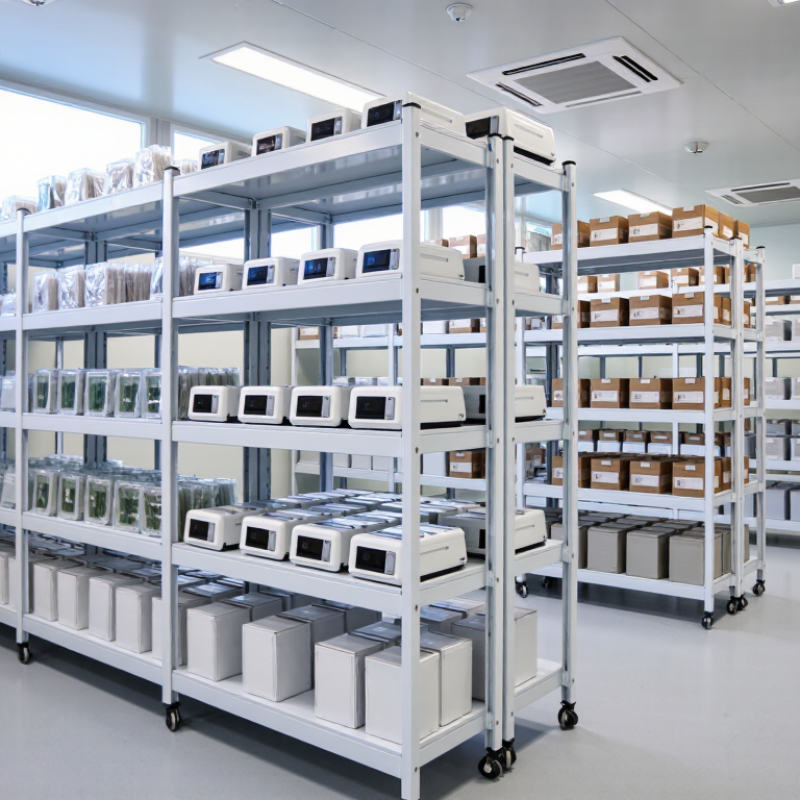
Sterile medical device storage requirements begin with a clear definition: the package must remain intact, dry, clean, identifiable, and protected from contamination. ISO 11607-1 and ANSI/AAMI ST79 emphasize validated packaging, controlled handling, and storage conditions suited to the device. A practical room should limit dust, moisture, sunlight, pests, and unnecessary traffic. Keep cartons off the floor and away from walls, ceilings, sinks, and sprinkler discharge zones. Leave enough space for inspection and airflow.
Temperature and humidity limits should come from packaging validation and facility risk assessment, not guesswork. Record readings with calibrated instruments, including excursions and corrective actions. Inspect every package before release. Reject or quarantine packs with punctures, crushed corners, wetness, broken seals, or faded labels. Wiping the outside does not restore sterility. Event-related sterility may remain valid until packaging damage occurs, but local procedures must define shelf-life controls and rotation rules.
The WHO Global Report on Infection Prevention and Control (2022) estimates that healthcare-associated infections affect about 7 in 100 patients in high-income countries and 15 in 100 patients in low- and middle-income countries. Storage is only one factor, yet weak controls can add avoidable risk. Staff should document lot numbers, locations, inspections, environmental readings, and training. Review failures honestly. A perfect checklist can still miss a damp carton hidden behind older stock. That uncomfortable detail deserves attention.
| Storage Dimension | Requirement or Acceptance Criteria | Recommended Control Method | Records and Evidence | Corrective Action |
|---|---|---|---|---|
| Manufacturer-Defined Conditions | Store the device within the temperature, humidity, light, orientation, and shelf-life conditions specified on the product label, packaging, instructions for use, or validated technical documentation. | Maintain a controlled storage specification for each device family and review it during product and packaging changes. | Approved product specifications, labeling records, storage procedures, and change-control documentation. | Quarantine affected stock when labeled conditions are exceeded until a documented impact assessment is completed. |
| Temperature | Use the labeled temperature range as the controlling requirement. There is no single universal storage temperature for all sterile medical devices. If a reference is needed, controlled room temperature is commonly defined as 20–25 °C with permitted excursions of 15–30 °C, but this range must not replace device-specific validation. | Use calibrated data loggers or continuously monitored sensors in representative hot and cold locations. Establish alarm limits below the maximum allowable excursion. | Calibration certificates, temperature maps, continuous monitoring reports, alarm investigations, and excursion assessments. | Identify the affected lot and duration of exposure, assess packaging and product risk, and release or reject stock based on documented technical justification. |
| Relative Humidity | Maintain the humidity range defined by the device manufacturer or packaging validation. No universal relative-humidity range applies to every sterile medical device. | Use calibrated humidity sensors where packaging materials, seals, coatings, adhesives, or product performance may be humidity-sensitive. | Humidity trend records, environmental qualification reports, packaging validation, and deviation records. | Inspect packaging for swelling, distortion, delamination, seal changes, corrosion, or other damage before disposition. |
| Packaging Integrity | The sterile barrier system must remain intact, clean, dry, sealed, and free from punctures, tears, holes, crushed areas, delamination, or compromised seals. | Protect packages from sharp edges, compression, excessive stacking, water, dust, and unnecessary handling. Perform visual inspection before picking and shipment. | Receiving inspection records, warehouse inspection checklists, nonconformance reports, and packaging validation records. | Quarantine damaged units or cases. Do not release a device with a compromised sterile barrier unless it is reprocessed and relabeled through an approved process. |
| Cleanliness and Contamination Control | Storage areas should be clean, dry, orderly, pest-controlled, and protected from dust, chemicals, aerosols, moisture, and other contamination sources. Sterile packages do not normally require storage in a sterile room. | Use documented cleaning schedules, controlled access, suitable housekeeping practices, and segregation from chemicals, waste, and nonconforming products. | Cleaning logs, pest-control records, environmental inspection reports, and access-control records. | Remove contaminated or visibly soiled packages from available stock and investigate the source and extent of contamination. |
| Light and Radiation Exposure | Protect devices and packaging from direct sunlight, ultraviolet exposure, and other radiation when these conditions may degrade materials, labels, adhesives, or product performance. | Use covered shelving, opaque outer packaging, or a controlled-light storage area when required by the product specification. | Storage-area inspection records, packaging studies, and product-specific environmental requirements. | Assess exposed stock for changes in packaging, labeling legibility, material degradation, or product performance before release. |
| Handling and Shelving | Store cartons and sterile packages in a manner that prevents crushing, bending, puncture, moisture contact, and excessive stacking. Maintain clear access for inspection and stock rotation. | Use stable shelving or pallets, avoid overloading, keep packages away from leaking equipment and high-traffic damage zones, and follow validated stacking limits. | Warehouse layout, stacking instructions, handling procedures, and routine inspection records. | Repackage or quarantine units with handling damage. Review stacking, pallet configuration, and employee training if repeated damage occurs. |
| Inventory Rotation and Expiry | Use first-expire, first-out control where expiry dates are assigned. Do not use a device after its labeled expiration date unless a formally approved and applicable shelf-life extension process exists. | Use lot-level inventory control with expiry alerts and documented stock checks. | Inventory transaction history, expiry reports, lot traceability records, and stock-count documentation. | Quarantine expired or untraceable units and dispose of them according to the quality system and applicable requirements. |
| Transport and Transfer | Transport and internal movement must not expose the device or sterile barrier system to conditions that could compromise safety, performance, or sterility. | Use protective shipping containers, appropriate cushioning, environmental controls when specified, and defined loading and unloading practices. | Shipping records, temperature or humidity data when required, carrier qualification, and delivery inspection records. | Investigate excursions, wet cartons, impact damage, missing seals, or other evidence of transport-related compromise before release. |
| Shelf-Life Validation | The labeled shelf life should be supported by documented packaging and product stability evidence. Sterility is maintained by the sterile barrier system until the package is opened, damaged, or otherwise compromised. | Conduct real-time and, where justified, accelerated aging studies with package integrity and functional testing at defined intervals. | Stability protocols, aging reports, seal-strength results, package-integrity test results, and shelf-life approval records. | Review affected lots and labeling if stability results fail or if storage conditions invalidate the supporting evidence. |
| Monitoring and Alarm Response | Environmental monitoring equipment must be suitable for the defined range, calibrated, maintained, and capable of identifying excursions that may affect product quality. | Define monitoring locations, sampling frequency, alarm limits, response times, data retention, and escalation responsibilities. | Sensor calibration records, alarm logs, monitoring graphs, maintenance records, and documented investigations. | Record the event, determine the affected products and exposure period, correct the environmental cause, and document final disposition. |
| Applicable Quality-System References | Storage requirements should be established and controlled through the organization’s quality system and aligned with applicable regulations, product labeling, and validated packaging processes. | Use risk management and documented procedures consistent with ISO 13485, ISO 11607-1, and ISO 11607-2, together with applicable national requirements. | Risk assessments, procedures, training records, audits, validation reports, and management-review inputs. | Open a corrective and preventive action process when recurring storage failures, inadequate controls, or systemic documentation gaps are identified. |
Use a restricted, low-traffic room with smooth, cleanable surfaces. Keep packages away from floors, walls, ceilings, and sprinklers. Less handling helps.
Many facilities use about 20–23°C and 30%–60% relative humidity. Confirm the device instructions and local requirements before setting limits.
Use calibrated sensors, alarms, and maintenance records. Check readings daily. Review unusual changes, such as repeated door openings or seasonal humidity.
Quarantine packages with crushed corners, wet spots, torn seals, dust, or punctures. Inspect every surface, including areas beneath shipping labels.
Keep cartons on clean, stable shelves. Leave space for airflow and cleaning. Place heavy items below. Do not overload shelves.
Use a first-expire, first-out system. Store newer packages behind older ones. Check package integrity before issuing any device.
Clearly separate released, expired, damaged, and quarantined stock. Use visible status labels. Keep accurate location records for every transfer.
Demonstrate inspection, cleaning, spill response, and access procedures. Signed attendance is not enough. Review trends monthly, because records alone can hide recurring problems.
Sterile medical device storage requires a controlled system that protects product sterility, packaging integrity, and traceability from receipt through use. What are the storage requirements for sterile medical devices? They generally include clean and suitable storage areas, controlled environmental conditions, adequate ventilation and lighting, protection from moisture, dust, pests, and excessive temperature changes, and equipment that supports safe handling. Storage spaces should be organized to prevent damage, contamination, and confusion between different device types or status categories.
Effective procedures should define packaging inspection, shelving arrangements, stock rotation, inventory checks, and separation of damaged, expired, or questionable items. Staff must handle devices carefully, follow hygiene practices, and record receiving, movement, environmental monitoring, inspections, and corrective actions. Regular reviews can identify risks such as overcrowding, unsuitable shelving, incomplete records, or repeated packaging damage. By combining documented procedures, routine monitoring, employee training, and continuous improvement, organizations can maintain sterile storage conditions and support the safe, reliable availability of medical devices.

 Onyx Medical